
Many wholesalers and distributors assume their payment systems are working fine. ACH is cheap. Checks are familiar. Credit applications are a necessary evil. Customers are used to it, so why change?
Underneath these familiar processes is a growing financial drain. Traditional B2B payment systems, the same ones companies have relied on for decades, are quietly eating into margins. Legacy payments were built for a world where transactions were slower and paper-driven, but today’s market is the complete opposite.
In this article, we break down how outdated B2B payment processes are eroding profitability, and why modernizing payments is becoming a strategic priority for every wholesaler and distributor.
Legacy processes create invisible financial strain
For a lot of suppliers, revenue appears healthy on paper while profits quietly erode in the background. The cause is rarely a single broken workflow, but dozens of smaller inefficiencies that tie to legacy payment systems.
Most finance and AR teams spend far more time managing payments than collecting them, with daily admin including:
- Sifting through remittance emails
- Matching ACH deposits to invoices by hand
- Correcting small errors that trigger disputes
- Updating records across disconnected systems
- Processing paper checks
This work doesn’t show up as a line item in reporting, but it carries a very real cost in labor, delays, and operational risk. Outdated solutions like this create a drag on profitability that compounds month after month.
Credit and invoicing workflows are a key issue
Legacy payment systems introduce daily operational risks that accumulate over time. Suppliers accept these issues as just the way things are, but they create real problems that modern systems are designed to eliminate.
When payments rely on paper invoicing, email chains, and manual reconciliation, mistakes are inevitable. Even well-trained teams make errors when their processes aren’t agile enough for customer needs, and each error chips away at the fragile relationship between buyers and suppliers.
Friction starts from the credit application
Buyers with high intent frequently hit delays caused by long credit applications, manual reviews, and multi-day approval cycles. Momentum fades quickly, along with purchases.
The bigger issue isn’t just the time it takes. Many in-house credit programs have low approval rates, meaning buyers invest their time in a slow, outdated process only to be declined anyway. This inefficiency hurts both sides.
- Buyers lose trust and either scale back their purchasing or switch suppliers
- Sales reps lose deals they should have won
- Wholesalers absorb the cost of reviewing applications that never convert
It’s a double loss of wasted operational effort and lost revenue. In a competitive market, buyers denied credit, after waiting days for a decision, often take their business to suppliers with faster, more flexible, and higher-approval financing options.
-1.png?width=373&height=158&name=John%20Smith%20(20)-1.png)
Manual processing costs add up in the background
Paper checks still account for 40% of US B2B payment volume, and this single manual process alone can lengthen DSO by several days. Even a 5-day DSO reduction can unlock meaningful working capital for merchants, making digital payments more important than ever when it comes to managing margins.
PYMNTS research found that firms relying on manual AP/AR workflows spend nearly three times more per transaction than those that automate. This costs businesses an average of $171,340 per year and 125 admin hours per week.
It’s estimated that paper-based processes cost as much as $8 more per transaction than electronic invoicing. With large-scale adoption of digital payment processes, U.S. businesses could collectively save over $100 billion every year.
Errors and delays multiply inside manual workflows
Even after credit is approved, billing introduces a second round of friction. Legacy workflows typically make it hard to see which invoices are outstanding, which payments are in transit, and which customers pose a heightened risk to the company. This lack of visibility slows down decision-making across teams.
Buyers feel the impact too. They may struggle to get updated balances, line-item details, or clear payment instructions, which introduces friction at the exact moment when they should feel confident about making a purchase. Digitization reduces this dependency by standardizing approvals and payments, and ensuring work moves forward, even when workloads spike.
Workflows can be streamlined even further by partnering with financial providers (like Credit Key) who can digitize the entire application, approval, and payments process, as well as offering instant credit decisions with an outsourced Net 30 program.
Reconciliation delays impact working capital
Payments may come in, but outdated systems create long lags between receiving a payment and applying it. AR teams can spend hours matching bank statements to invoice numbers, interpreting incomplete remittance data, or hunting down missing payment details across email threads. While this is happening:
- Cash sits idle instead of funding inventory
- Purchasing cycles slow
- Liquidity tightens even when sales are strong
This is one of the most expensive forms of inefficiency, and one of the most common issues with legacy payment systems.
Aging receivables lead to permanent margin loss
When errors or delays push invoices into 60, 90, or 120-day territory, the likelihood of collecting that revenue plummets.
Long resolution times can damage buyer relationships, and credit teams may reduce their limits as a precaution. This results in immediate lost revenue, and reduced loyalty and growth from buyers over time.
79% of merchants say they want to receive digital payments including wire, ACH, and virtual cards, while 76% believe that buyers are more likely to pay on time when they pay electronically. However, most legacy payment processes can’t support this level of flexibility.
Bad data compounds every operational weakness
The final workflow cost is the one that impacts everything else down the chain, and that’s data quality. Legacy credit and invoicing systems create fragmented, inconsistent records that can undermine the accuracy of things like:
- Customer data
- Pricing
- Forecasting
- Financial reporting
- Inventory planning
This inaccurate data makes teams work harder, as well as making future automations or AI adoption significantly more complex.
Why a poor customer experience impacts profitability
For most B2B buyers, payments are a direct reflection of how easy (or painful) it is to make a purchase. When payment systems feel slow or fragmented, customers start to weigh up their options. They either adjust their purchasing behavior, or shift their spend to competitors who make things simple for them.
Slow, manual credit approvals break the buying momentum
Modern B2B buyers expect the speed and convenience of a B2C payment experience. But legacy credit workflows force them into a process that feels like stepping back in time, with multi-page forms and days spent waiting for approvals. During that gap, urgency disappears and buyers reconsider their orders. These lost sales rarely get tracked, as they never happen.
Payment friction signals that a supplier is hard to do business with
Outdated systems make even simple tasks feel complicated. Buyers may have to:
- Call or email for a credit limit
- Request invoice copies
- Hunt for remittance instructions
- Switch devices to order because checkout isn’t mobile friendly
Each point of friction creates micro-moments of frustration, and those accumulate into a clear message: this supplier slows me down. In B2B, that’s enough to push a buyer toward a competitor who offers a smoother experience.
.png?width=416&height=134&name=John%20Smith%20(21).png)
Billing uncertainty erodes trust
Incorrect invoices and mismatched pricing are common in legacy workflows. For each error, there’s a chain reaction of emails, corrections, calls, and re-approvals. A high-volume distributor might lose thousands each month simply because teams are fixing mistakes that modern payment systems would prevent.
Rigid payment terms ignore real buyer needs
Most buyers want flexible payment structures that align with their unique cash cycles. When systems can’t support installment plans, extended terms, or instant credit, buyers either spend less or turn to competitors who offer what they need.
In industries with thin margins, the inability to offer flexible terms doesn’t just cut into immediate profits, it also reduces customer lifetime value.
A poor mobile experience kills reorders
Buyers in construction, field services, retail, and manufacturing are increasingly placing orders from their phones. Outdated payment systems that aren’t mobile-friendly result in:
- Abandoned carts
- Missed reorders
- Lost opportunities to upsell
- Reduced buyer satisfaction
If buyers can check out instantly on Amazon Business with any device, but have to call or email to place an order with a supplier, they notice the difference and adjust their purchasing habits accordingly.
B2B buyers have a multitude of options for suppliers across industries, so if a supplier makes payments difficult, buyers will simply shift their spend. This impact is subtle at first (a smaller order here, a delayed order there), but over time this can lead to significant profit leakage.
How legacy payments increase fraud risk
Fraud has become one of the most expensive and fastest-growing risks in B2B payments, and legacy processes leave the door wide open for bad actors.
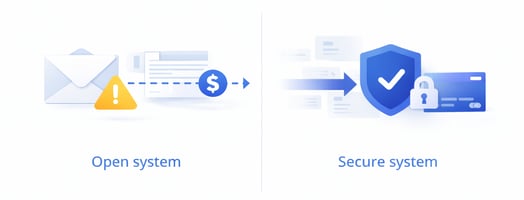
Paper checks, emailed invoices, and manual verifications create easy entry points for fraudsters who exploit human error and outdated controls. Business email compromise (BEC) and fake vendor account changes often succeed precisely because AR teams rely on outdated payment processes.
Most legacy systems depend on people noticing that something doesn’t look right. A slightly altered bank account number or a fake invoice slipped into a high-volume AP queue can go unnoticed until it’s too late.
AR and AP teams are highly skilled, but no human process can match the scale or sophistication of today’s fraud attacks. Fraudsters increasingly target industries like distribution where payments move quickly and verification processes lag behind.
Email-based invoicing is a fraudster’s ideal entry point
When critical payment details move through email or unencrypted PDFs, fraud risk jumps dramatically. Common scenarios include:
- Fake invoices from lookalike email domains
- Requests to update bank details sent to AP clerks
- Intercepted invoices with altered routing information
Because these interactions happen outside of secure systems, it’s incredibly difficult for teams to confirm the authenticity of every request. One moment of distraction can mean significant losses which modern payments solutions could have easily prevented.
Digitizing payment systems can help prevent fraud attacks
Automated payment systems use AI and real-time intelligence to prevent fraud before it impacts a business. These platforms can:
- Validate bank account changes instantly
- Detect anomalies in payment behavior
- Flag transactions that deviate from historical patterns
- Use device, network, and behavioral data to identify suspicious activity
Instead of relying on a tired AP clerk to catch an irregularity, advanced systems apply machine learning and continuous monitoring to shut down threats early. Transitioning to digital payments and embedded financing is a way to future-proof financial operations and maintain profitability.
Why legacy payment systems break when you try to scale
Traditional B2B payment systems become increasingly fragile as the business grows. What works at $10M in revenue becomes chaotic at $50M, and nearly unmanageable at $100M. Scaling exposes operational weaknesses that stay hidden when order volume is low, and those weaknesses can multiply faster than revenue does.
Internal knowledge is not a scalable system
Many wholesalers and distributors still rely on a handful of people who “know how the system works.” These individuals understand:
- All the quirks in the ERP
- Where invoices tend to get stuck
- Which customers need manual review
- How to navigate any exceptions that their software stack can’t handle
This valuable internal knowledge is invisible until it suddenly becomes a liability. Someone goes on vacation, a key AR specialist resigns, or a new wave of customers stretches the old process beyond capacity. When critical workflows depend on specific humans instead of automated systems, profits immediately take a hit.
Busy seasons turn weak spots into bottlenecks
Seasonal spikes, contract renewals, and end-of-quarter pushes can overwhelm manual payment processes. Instead of supporting growth, payment systems begin to struggle.
The result is a stressful cycle where teams work harder just to keep pace, and customers experience the impact of this friction during the most important buying periods of the year. A customer ready to place a $20K order shouldn't have to wait days for an approval that could be automated. But with legacy payments, this is still a fact of doing business.
Disconnected payment systems increase the risk of mistakes
Disconnected ERPs, CRMs, eCommerce stores, and AR tools often require teams to export, re-enter, or manually sync data between systems. This creates a real risk of:
- Pricing errors
- Incorrect credit decisions
- Duplicated or missing customer records
When data lives in silos, every transaction increases the risk of error. Integrated systems eliminate these gaps, feeding accurate customer, inventory, and payment data into every workflow.
Compliance becomes harder to maintain
Tax regulations, data privacy standards, and industry requirements change quickly. For many distributors, operational risk is what ultimately caps their ability to scale.
Manual systems struggle to keep up with these changes, leaving companies with compliance risks they may not even be aware of. Errors here can lead to audits, fines, or regulatory obstacles that damage both margins and brand reputation.
Why modern payment infrastructure has become a competitive advantage
B2B payments have shifted from a back-office function to a direct driver of revenue. When buyers can get instant credit decisions, check out from any sales touchpoint, and pay using flexible terms, the conversion rate rises — especially for high-ticket and time-sensitive orders. Digital workflows also shorten DSO by automating invoicing, reconciliation, and reminders, which unlocks working capital and helps suppliers reinvest in inventory and growth.
Just as importantly, payments now define the customer experience. Buyers prefer suppliers who make it easy to manage cash flow and pay on their own terms. Embedded financing and mobile-friendly checkout help to expand order sizes and repeat purchases, while secure digital rails reduce fraud and eliminate mistakes that are common in manual workflows.
As expectations continue to shift toward speed and transparency, suppliers using modern payment infrastructure (such as embedded BNPL solutions like Credit Key) are capturing more wallet share and building longevity into their customer relationships.
In summary
Legacy payment systems have quietly drained profits from B2B businesses for years through slow, manual processes and unnecessary operational risks. As more of the buying journey moves online and becomes automated, these outdated systems are becoming a major barrier to growth.
Modern payment solutions like embedded financing give merchants what legacy systems never could, offering a smoother customer experience and the ability to scale faster.